
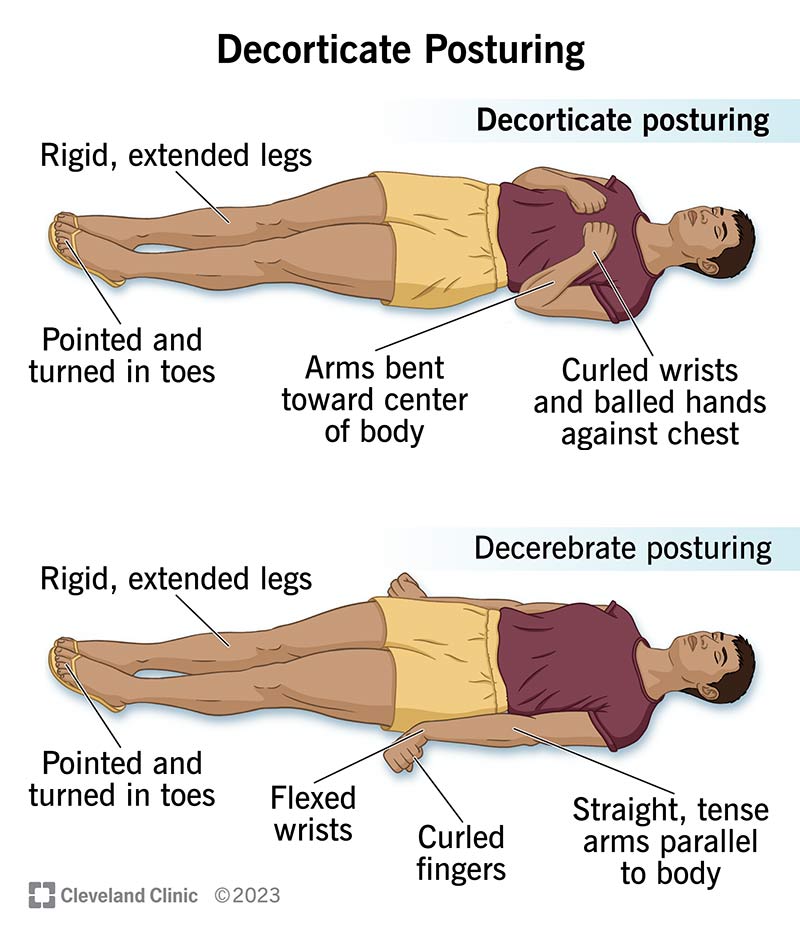
The Glasgow Coma Scale (GCS) evaluates neurological responsiveness across three domains: eye opening (E1, E4), verbal output (V1, V5), and motor response (M1, M6). The motor component carries the strongest predictive value for clinical outcomes after severe traumatic brain injury. Clinicians check motor response by delivering a standard central noxious stimulus, like a trapezius squeeze or supraorbital pressure, when a patient cannot follow commands.
Normal motor function earns an M6 for following commands. Purposeful movement toward a stimulus scores an M5 (localizing pain), while pulling away without localizing scores an M4 (normal withdrawal flexion). Decorticate flexion drops the patient straight to an M3. The movement is slow, stereotyped, and stiff, lacking purposeful avoidance. Decerebrate posturing yields an M2. An M2 score indicates advanced failure of brainstem structures, placing the patient directly above complete flaccidity (M1). Patients presenting with an initial motor score of M2 or M3 enter the highest-risk category for mortality, demanding rapid airway protection and continuous intracranial pressure monitoring.


