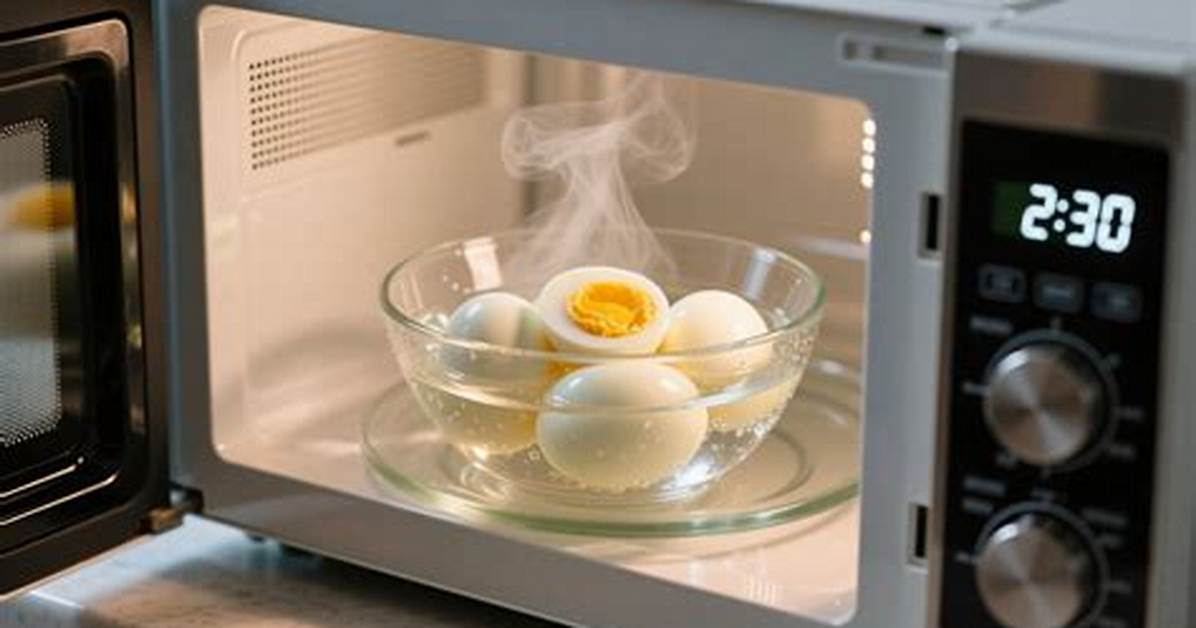
Microwave ovens heat food by emitting non-ionizing electromagnetic radiation at roughly 2.45 gigahertz. Water molecules, fats, and sugars absorb these waves and vibrate rapidly, generating thermal energy. In raw or loose foods, steam escapes easily into the air. A hard-boiled egg, however, presents a completely different structural barrier. Both the dense, coagulated ovalbumin of the white and the lipid-heavy yolk form a tight, solid cross-linked protein scaffold.
Research presented to the Acoustical Society of America by researchers Anthony Nash and Lauren von Blohn demonstrated that microwaved egg yolks heat far faster than surrounding water baths. The yolk contains pocketed water trapped under intense mechanical restraint. Cut off from atmospheric release, this moisture becomes superheated, rising well beyond the normal boiling point of 212°F while remaining trapped in a liquid state.
When the solid protein matrix can no longer contain the internal vapor pressure, or when an external utensil disturbs the boundary layer, the equilibrium shatters. All the superheated water pockets flash into high-pressure steam at once. The rapid expansion blows the egg apart with force rivaling small pyrotechnics. Nash and von Blohn recorded peak acoustic levels ranging from 86 to 133 decibels at a distance of just 30 centimeters, a blast loud enough to rival a shotgun shell or a commercial jet takeoff, posing genuine acoustic trauma risks alongside ballistic hazards.