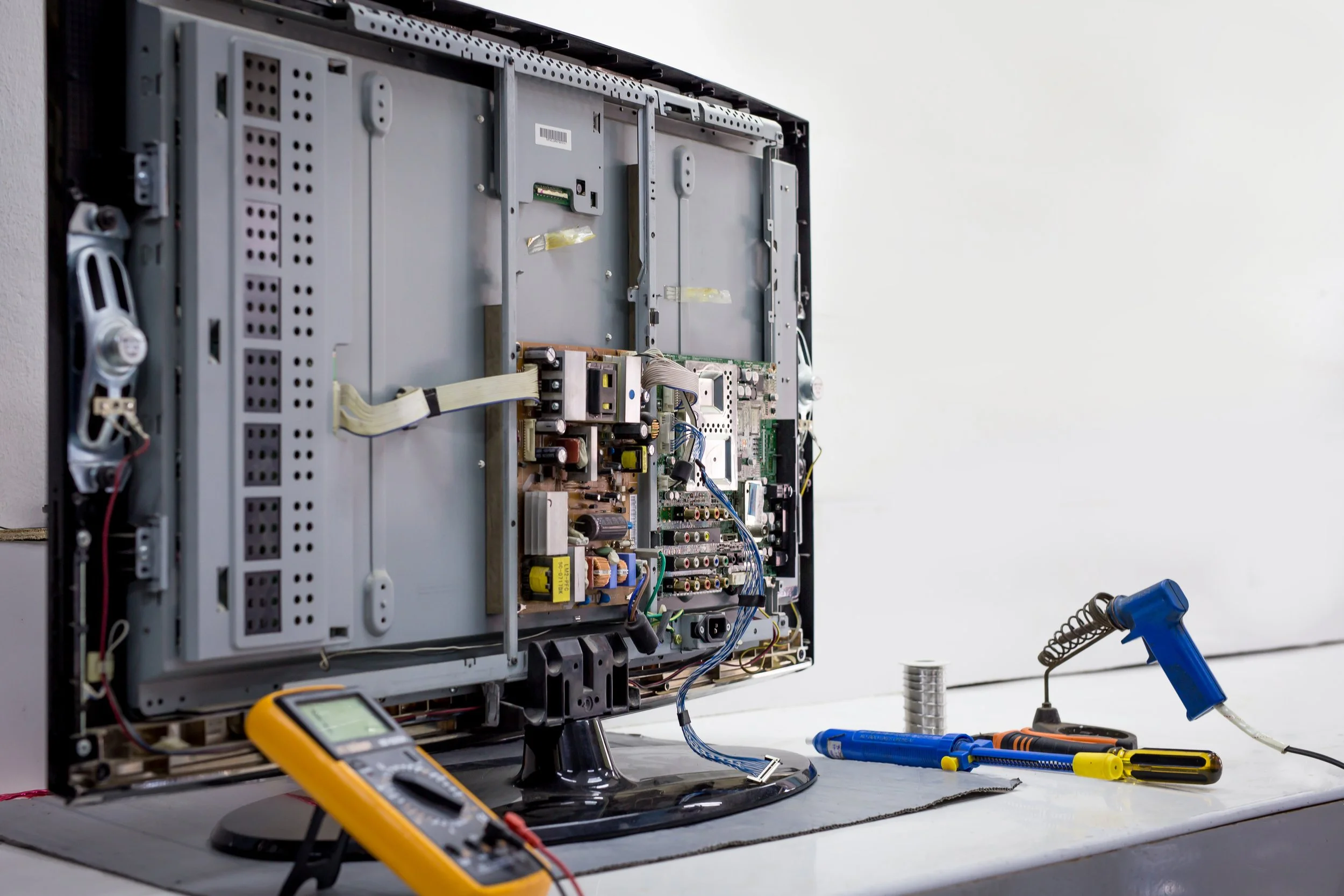
Beneath the glass, modern smart televisions have shed almost all their internal complexity. Where older electronics featured sprawling circuits, today's chassis typically houses just three main modules: the power supply board, the main logic board, and the timing controller (T-Con) board.
| Failure Type | Typical Diagnostic Symptoms | Component Cost Range | Repair Viability |
|---|---|---|---|
| Physical Panel Fracture | Webbed cracks, bleeding black ink, distorted vertical bars | $350, $1,200 | Economically unviable; recycle unit |
| Backlight Array Burnout | Sound plays normally; image visible only under direct flashlight beam | $30, $85 | High viability for patient DIYers |
| Power Board Failure | No power, dead standby light, clicking relays, bulging capacitors | $40, $110 | Excellent candidate for board swap |
| Main Board Lockup | Endless boot loops, frozen smart UI, unresponsive HDMI ports | $65, $160 | Moderate; software pairing issues possible |
| T-Con Timing Fault | Solarized colors, ghosting trails, half-screen whiteout | $25, $70 | High viability; simple ribbon cable swap |
Component-level diagnosis has largely been discarded. Technicians rarely desolder individual surface-mount resistors or test micro-diodes with oscilloscopes. Instead, service has evolved into modular swapping: identify which of the three internal circuit boards failed, unplug it, and insert an identical used board harvested from a cracked-screen donor.
Even this straightforward swap method faces growing friction. Power supply board repair remains relatively accessible because high-voltage AC conversion relies on discrete components. Blown capacitor symptoms, domed tops, leaking electrolytic fluid, or scorched PCB areas, remain easy to spot with the naked eye. Anyone with basic soldering skills can replace a swollen 10-volt capacitor for $3.
Trouble begins when failures strike the main logic board. Modern sets run custom system-on-chip (SoC) architectures running proprietary forks of Android TV, webOS, or Tizen. If a system processor develops micro-fractures in its solder balls from thermal expansion cycles, repairing it requires infrared BGA rework stations costing thousands of dollars.